Logo

Open Positions

Join our research team at the University of Trento.

PhD Position: Grain-boundary engineering for high performance thermoelectric devices via local-scale structure-property correlations

Advisors: Eleonora Isotta (University of Trento; Max Planck Institute for Sustainable Materials, Germany), Narges Ataollahi (University of Trento)

Participants: Christina Scheu (Max Planck Institute for Sustainable Materials, Germany)

PhD Strategy Imaging

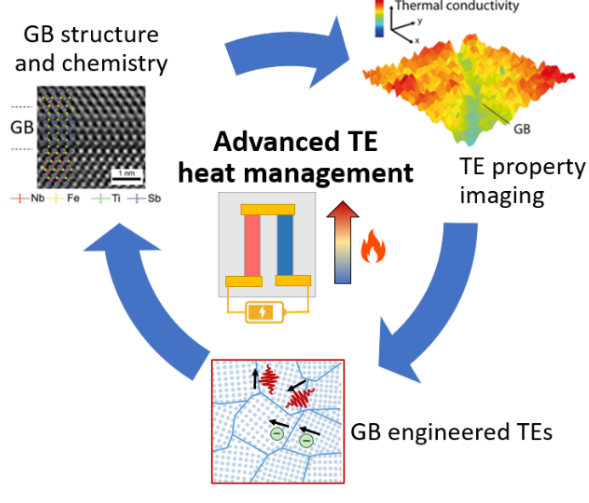
Proposed strategy to correlate thermoelectric properties via imaging (https://doi.org/10.1002/adma.202302777) with analysis of grain boundary structure and chemistry, to obtain high performance.

Thermoelectric (TE) devices are attractive for waste-heat energy harvesting, as well as for cooling and heating applications due to their versatile, reliable, and refrigerant-free operation. A particularly promising application of TEs is device-level heat management, which is increasingly critical for achieving high performance and efficiency in technologies such as batteries, advanced electronics, and hardware for computing and datacenters. The cooling performance of TE devices is linked to the materials figure of merit, zT, which is proportional to the ratio of electrical (σ) to thermal conductivity (κ). State-of-the-art TE materials typically reach zT ~ 1.1–1.4 near 300 K. Achieving reproducible zTs ~1.3–1.7 would render TEs technologically competitive, thus enabling their integration into heat management systems.

PhD Objective and methodology

In this PhD thesis, we propose to achieve high zT via advanced grain-boundary engineering. GBs offer a compelling and novel material design space. In fact, recent literature suggests that: (i) GBs behave as ‘phases’ and can thus exist in multiple forms, with different local chemistry and structural arrangements; (ii) the type of GBs can have major impact on its thermal and electrical transport. TE research typically relies on macroscale measurements of κ and σ, incapable of distinguishing the role of individual GBs. As such, what GB types are beneficial for TEs remains unclear. We recently demonstrated that measuring κ for individual GBs is possible (Fig 1). Measuring the σ of individual GBs was also recently shown in metals. However, these have never been put together: what GBs possess higher σ/κ remains unknown, though pivotal for rationally pursuing GB engineering in TEs.

The PhD researcher will develop a strong experimental background and will focus on (i) TE material synthesis and characterization, including with thermal conductivity imaging (FDTR thermoreflectance), local electrical measurements, and electron microscopy; (ii) data analysis and theoretical/analytical interpretation of results; (iii) TE device assembly and optimization. Outcomes will include publications in international scientific journals as well as presentations at national and international conferences. The candidate will develop an attractive profile for a career in industry R&D, as well as academia.

Working environment:

This project is one of the key milestones of HEAT FIS-3 Starting Grant, and will be carried out at the Energy and Materials Laboratory. Electron microscopy investigations will be carried out in collaboration with the Max Planck Institute for Sustainable Materials, in Germany, where the candidate will have the opportunity of spending a research stay.

Candidate profile:

Student with a Master degree in Materials Science, Physics, Engineering, or related (to be acquired by 31st October 2026).

Beginning of PhD contract:

1st November 2026.

Contact: Interested candidates are invited to send their CV and Master’s transcript to Dr. Eleonora Isotta: eleonora.isotta@gmail.com

Funded by:

MUR Logo FIS Logo

Fondo Italiano per la Scienza FIS-3 Starting Grant – Project ‘HEAT’, FIS-2024-05016

Finanziata con il contributo del Ministero dell’Università e della ricerca ai sensi del D.D. n.18010 del 12 novembre 2025 – BANDO FIS 3.

PhD Position: Development of patternable heat guides for advanced thermal management in microelectronic and energy storage devices

Advisors: Eleonora Isotta (University of Trento; Max Planck Institute for Sustainable Materials, Germany), Paolo Scardi (University of Trento)

Participants: Himanshu Jain (Lehigh University, USA), Rossana Dell’Anna (Bruno Kessler Foundation), Elena Missale (Bruno Kessler Foundation)

PhD Strategy Imaging

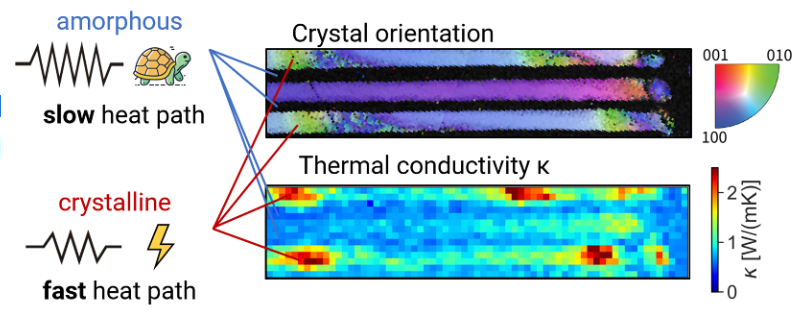
Heat guides in Sb2S3 obtained via laser-induced crystallization. Thermal conductivity κ imaging with micron resolution shows a κ contrast between amorphous and crystalline areas. See: doi.org/10.1002/adfm.202517850

The electrification of industrial, automotive, and domestic sectors plays a major role in the transition to a more sustainable society. Many technologies critical to the electrification, including electronics, computing, and energy storage devices, are limited by our ability to efficiently manage the heat they generate. In microelectronics, increasingly miniaturized and higher-performance devices result in heat dissipation requirements often beyond current capabilities. Batteries, power electronics, and laser diodes require precise temperature control, as operating outside their optimal range reduces efficiency. Additionally, devices must be able to dynamically respond to changes in environment or operation, and to manage localized and potentially failure-inducing events like hotspots.

To meet the demands of next-generation technologies, we need new, advanced solutions for managing heat efficiently and at localized, reconfigurable locations.

One attractive opportunity for localized channeling of cooling and heating loads is laser patterning of semiconductor materials. Inducing phase changes in materials via lasers is commonly used for reversible memory storage. Laser processing was also recently used to write microscale crystal patterns in chalcogenides (Figure) and silicon.

PhD Objective and methodology

The goal of this PhD project is the development of laser-patterned heat guides to deliver heating and cooling loads at reconfigurable, submicron locations of a target battery or microelectronic device. The PhD researcher will work on laser-manufacturing methods to write and reconfigure heat-guide patterns, test their thermal conduction performance, and demonstrate the possibility of delivering heat at submicron locations via nanoscale patterning techniques.

The PhD researcher will develop a strong experimental background in advanced manufacturing of semiconductor materials, as well as characterization using scanning electron microscopy (SEM), temperature imaging, and thermal conductivity imaging via thermoreflectance (FDTR). Work will also focus on developing a theoretical (analytical) interpretation of thermal transport results, with potential modelling integration. Outcomes will include publications in international scientific journals as well as presentations at national and international conferences.

Working environment:

This project is one of the key milestones of HEAT FIS-3 Starting Grant, and will be carried out at the Energy and Materials Laboratory. The project is in collaboration with the Bruno Kessler Foundation, and the Materials Science Dept. at Lehigh University, USA, where the PhD researcher will have the opportunity to spend a research stay.

Candidate profile:

Student with a Master degree in Materials Science, Physics, Engineering, or related (to be acquired by 31st October 2026).

Beginning of PhD contract:

1st November 2026.

Contact: Interested candidates are invited to send their CV and Master’s transcript to Dr. Eleonora Isotta: eleonora.isotta@gmail.com

Funded by:

MUR Logo FIS Logo

Fondo Italiano per la Scienza FIS-3 Starting Grant – Project ‘HEAT’, FIS-2024-05016

Finanziata con il contributo del Ministero dell’Università e della ricerca ai sensi del D.D. n.18010 del 12 novembre 2025 – BANDO FIS 3.